ANVISA – RDC 998/2025 – Regulation of the Brazilian Health Surveillance Agency
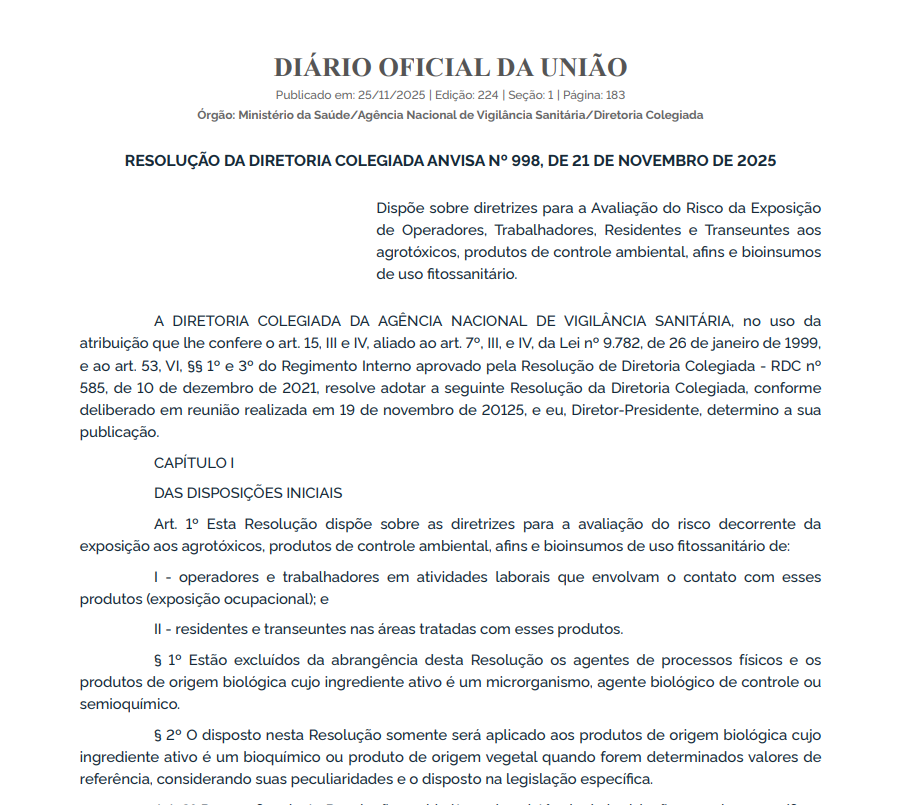
The National Health Surveillance Agency (ANVISA) has published Resolution of the Collegiate Board (RDC) 998/2025
on November 25, 2025, which establishes guidelines for the Risk Assessment of Exposure
of Operators, Workers, Residents, and Bystanders to pesticides
, environmental control products and plant protection biocontrol products. A specific Technical Guidance on the topic will be published shortly.
Main Points:
- Mandatory non-dietary risk assessment, which considers operators, workers (re-entry), residents, and bystanders, both for new registrations and for modifications of already approved products.
- Definition of standardized technical guidelines, with criteria and parameters for exposure estimation.
- Creation of an Risk Assessment Dossier (DAROC) for occupational and resident/bystander exposure detailing all exposure scenarios under proposed product use conditions and allowing Anvisa to verify.
- Mandatory use of the Brazilian “avaliAR” Calculator, a standardized tool for exposure calculations based on Brazilian and international data.
- Assessments will be submitted in a phased transition, with different deadlines for new and registered products, ensuring gradual adaptation.
- Effective date: 180 days after official government publication (DOU).
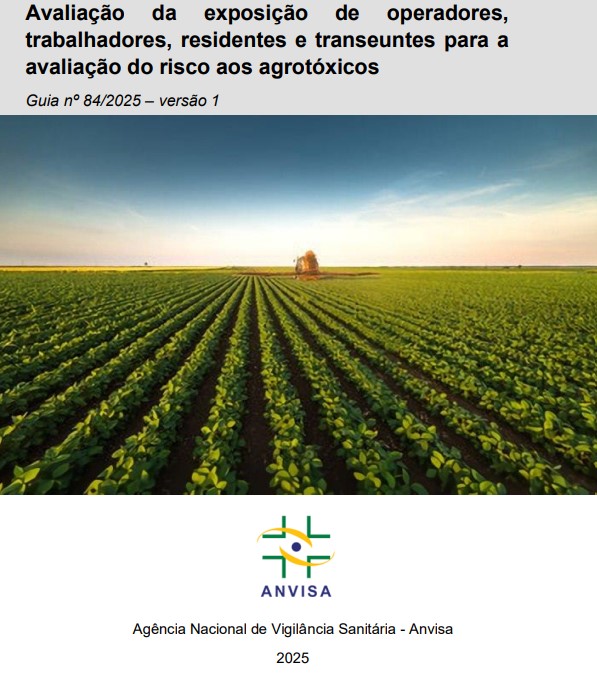
- Technical Guide
Along with the RDC, ANVISA will publish the 1st version of the Non-Dietary Exposure Assessment Guide, which describes recommendations, methods, criteria, and parameters to be used risk assessment. In this first version, parameters such as size of area treated per day, body weight and body surface area, transfer coefficient (TC), default values for DT50, RFD, RCD, RTT, are established, covering Brazilian representativeness. The document will be open for public consultation for 12 months, allowing for contributions to its improvement.
- The avaliAR Calculator
The avaliAR Calculator is the tool that will be provided by the National Health Surveillance Agency (ANVISA), developed through the Technical cooperation agreement – ACT – 02/2020, between ANVISA and the ProHuma Institute, which calculates the estimated exposure of operators, re-entry workers, residents, and bystanders in compliance – RDC 998/2025.
The avaliAR calculator standardizes the use of a single tool by applicants and product regulators in Brazil, providing users with a public and transparent tool that will be available with a user manual and easy-to-understand tutorial videos.
The first version is based on parameters, references, and data that predict exposure for the scenarios currently covered. The assessment following criteria developed within the ACT already covers the manual scenario (backpack, stationary, and semi-stationary). Exposure scenarios that have not yet been discussed follow the recommended approaches currently used by ANVISA and will be updated as technical discussions and assessment development progress, with the new ACT (2025 – 2030) that will be signed shortly, in order to obtain exposure estimates, as well as parameters and recommendations more representative of the Brazilian scenario.
- A Milestone for Pesticide Regulatory in Brazil
With this new regulation, ANVISA strengthens its role in health protection, providing both the regulatory agency and society with a stronger technical foundation to assess the risks associated with the pesticide uses. The regulation along with its technical criteria and parameters, brings Brazil closer to the international best practices, ensuring assessments that incorporates data representative of the Brazilian reality.The ProHuma Institute recognizes and celebrates the relevance of the technical work developed through the Technical Cooperation Agreement – ACT – between PROHUMA and ANVISA (2020 – 2025), which focused on scientific and technical initiatives aimed at protecting the health of rural workers, residents, and bystanders exposed to pesticides. Furthermore, the upcoming ACT is essential for continuing the development of an increasingly robust database and more representative, reliable parameters for assessing occupational and resident/bystander exposure risk, promoting greater safety for workers, rural population, and, more broadly ultimately, for Brazilian society as a whole.